


Introduction
In 2026, users are no longer relying only on traditional search engine results. Instead, AI-powered systems such as Google AI Overviews, ChatGPT, and Gemini are changing how information is discovered and consumed.
Rather than showing a list of links, Google now often delivers AI-generated summaries at the top of search results. These summaries are created by analyzing and combining information from multiple trusted sources across the web.
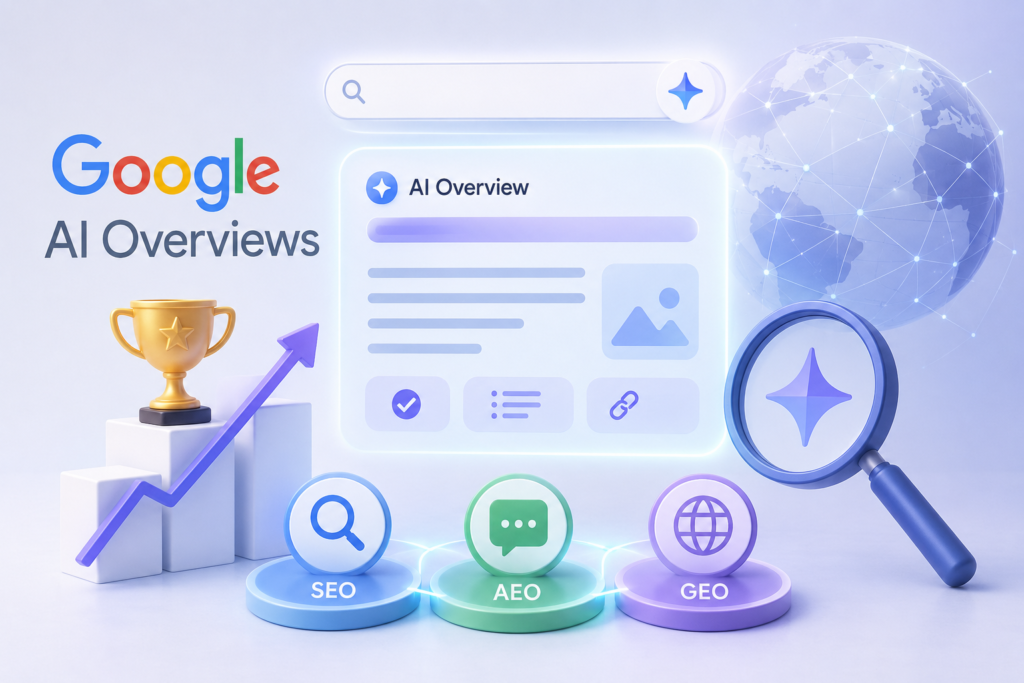
This shift has introduced a new optimization approach that goes beyond traditional SEO:
- Search Engine Optimization (SEO)
- Answer Engine Optimization (AEO)
- Generative Engine Optimization (GEO)
To stay visible in this new search ecosystem, businesses must optimize for all three.
This guide explains how to rank in Google AI Overviews in 2026 using practical, future-ready strategies.
What Are Google AI Overviews?
Google AI Overviews are AI-generated summaries that appear at the top of search results. Instead of listing multiple websites, Google synthesizes information from trusted sources and presents a direct answer.
The purpose of AI Overviews is to:
- Provide quick and accurate answers to user queries
- Reduce the need for multiple clicks
- Improve search efficiency
- Highlight reliable and authoritative content
When your website is used as a source in these summaries, it gains significant visibility, authority, and traffic potential.
Why Ranking in AI Overviews Matters in 2026
Ranking in AI Overviews has become more valuable than traditional organic rankings.
When your content is included in AI-generated responses, it leads to:
- Increased brand visibility
- Higher organic traffic
- Stronger topical authority
- Improved trust and credibility
- Better conversion rates
- More qualified leads
As a result, businesses are now shifting from traditional SEO alone to a combined approach of SEO, AEO, and GEO.
How Google AI Overviews Select Content
Google uses multiple quality and relevance signals to decide which content appears in AI-generated summaries.
1. Search Intent Relevance
Content must directly and clearly answer the user’s query. Pages that closely match search intent have a higher chance of being selected.
2. E-E-A-T (Experience, Expertise, Authority, Trust)
Google prioritizes content that demonstrates real-world experience, subject expertise, authority in the niche, and overall trustworthiness.
3. Content Clarity and Structure
Well-structured content is easier for AI systems to understand and extract. Clear formatting improves machine readability.
4. Source Authority
Websites with strong backlink profiles, brand mentions, and industry recognition are more likely to be cited.
5. Content Freshness
Updated and regularly maintained content is preferred in AI-generated results.
Core Strategies to Rank in Google AI Overviews
1. Focus on Direct Answer-Based Content (AEO Strategy)
AI systems prefer content that provides clear and direct answers.
Instead of vague explanations, your content should immediately address the query.
Example:
Weak:
This article explains SEO strategies for websites.
Strong:
SEO improves website visibility by optimizing content, technical structure, and backlinks to help pages rank higher on search engines.
The second format is more likely to be selected by AI systems.
2. Build Strong Topical Authority (GEO Strategy)
Google favors websites that demonstrate deep expertise in specific topics rather than surface-level content across unrelated areas.
For example, a website consistently publishing content on SEO, Local SEO, Google Ads, and AI-driven marketing will be considered more authoritative in that niche.
Topical authority is built through:
- Consistent content creation around a core subject
- In-depth coverage of subtopics
- Internal linking between related pages
3. Optimize for Generative Engine Understanding (GEO)
Generative engines rely on structured, meaningful, and semantically rich content.
To optimize effectively:
- Use clear heading hierarchy (H1, H2, H3)
- Write in simple, natural language
- Include FAQs written in question format
- Use accurate, entity-rich information
- Avoid vague or overly generic statements
The goal is to make your content easy for AI systems to interpret and reuse.
4. Improve Content Structure for AI Extraction
Well-structured content increases the chances of being extracted into AI summaries.
Best practices include:
- Short and focused paragraphs
- Bullet points for clarity
- Step-by-step explanations where needed
- Comparison tables when relevant
- Summary sections at key points
This improves both readability and machine understanding.
5. Strengthen E-E-A-T Signals
E-E-A-T is one of the most important factors for inclusion in AI Overviews.
To improve it, focus on:
- Adding author bios with real credentials
- Publishing case studies and real-world results
- Showcasing client work and testimonials
- Building brand mentions across the web
- Demonstrating real industry experience
Trust is a major deciding factor in AI content selection.
6. Implement Schema Markup
Structured data helps search engines better understand your content.
Key schema types include:
- Article Schema
- FAQ Schema
- Organization Schema
- Local Business Schema
Proper schema implementation increases eligibility for AI-based visibility.
7. Add FAQ Sections for AEO Optimization
FAQs improve your chances of appearing in AI-generated answers and featured snippets.
Example questions:
- What is Google AI Overview?
- How does AI decide search rankings?
- What is Generative Engine Optimization (GEO)?
- How can I rank in AI search results in 2026?
FAQs make content more conversational and query-ready.
8. Build Off-Page Authority and Brand Trust
External signals strongly influence AI selection.
Focus on:
- High-quality backlinks from relevant websites
- Brand mentions in authoritative publications
- Guest posting on niche websites
- Digital PR and press coverage
- Industry citations and references
A strong online presence increases trustworthiness in AI systems.
SEO vs AEO vs GEO
SEO (Search Engine Optimization)
Focuses on improving visibility in traditional search engine results.
AEO (Answer Engine Optimization)
Focuses on optimizing content to appear in direct answers, snippets, and voice search results.
GEO (Generative Engine Optimization)
Focuses on getting content cited in AI-generated responses such as Google AI Overviews and ChatGPT answers.
The most effective strategy is combining all three approaches.
Common Mistakes to Avoid
Avoid the following mistakes if you want to rank in AI Overviews:
- Publishing thin or low-value content
- Ignoring search intent
- Poor content structure and formatting
- Overusing keywords unnaturally
- Failing to update content regularly
- Lack of authority-building efforts
These issues reduce both user trust and AI visibility.
Future of AI Search Optimization
AI-driven search is becoming the primary method of information discovery.
Platforms like Google AI Overviews, ChatGPT, and Gemini will continue to expand their role in search experiences.
Businesses that adapt early will benefit from:
- Higher visibility across search platforms
- Consistent organic traffic growth
- Strong brand authority in their niche
- Increased lead generation opportunities
Conclusion
Ranking in Google AI Overviews in 2026 requires a shift beyond traditional SEO practices.
Success depends on a combined strategy that includes:
- Strong SEO foundations
- Answer-focused AEO content
- Generative engine optimization (GEO)
The key is to create content that is clear, structured, authoritative, and genuinely helpful to users.
In the era of AI search, the websites that provide the most trusted and useful answers will be the ones that are featured.